World Alzheimer’s Day: The latest research updates
 © Olga Ко – stock.adobe.com – generiert mit KI
Alzheimer's disease is the most common type of dementia, and those who suffer from it, their relatives and the healthcare system face great challenges. The risk for Alzheimer's increases as a person ages. World Alzheimer's Day on September 21 draws attention to this disease and its consequences every year. Current research findings show that changes in the brain can start many years before the first clinical symptoms occur. All the more important are new findings on how to detect the disease as early as possible, slow down its progression and specifically influence risk factors.
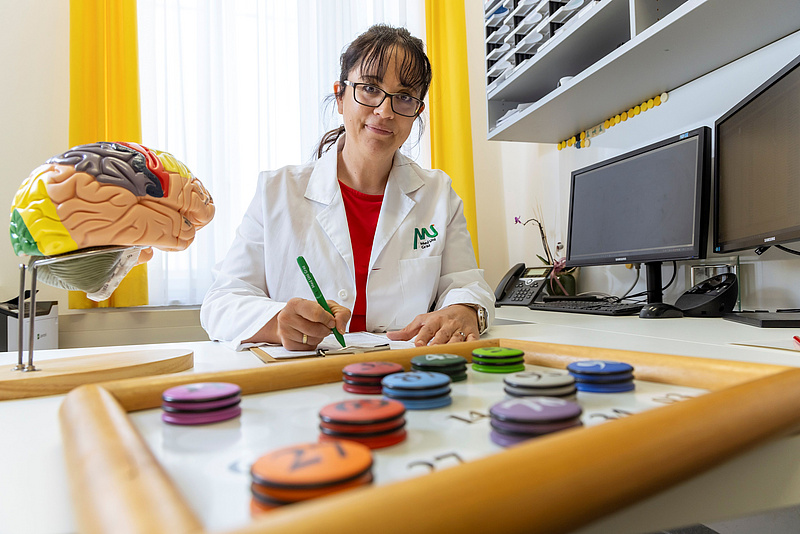
These questions are the subject of intensive research at the Medical University of Graz as well. Marisa Koini conducts research in the field of neuropsychology and neuroscience at the Department of Neurology and deals with cognitive changes in the course of aging.
Alzheimer’s does not start with the first symptoms
Alzheimer's disease develops insidiously. Pathological changes in the brain can develop long before memory issues are noticeable in daily life. These include certain protein deposits and changes in neurons and their communication. "If we want to understand and influence how Alzheimer's develops, we must investigate the disease as early as possible. At the time of diagnosis, the pathological changes in the brain are frequently well advanced. It's the early phase of the disease in particular that gives us the opportunity to understand the processes that determine how the disease will progress," explains Marisa Koini.
Thus modern Alzheimer's research focuses on early detection. Using imaging procedures, blood and cerebrospinal fluid biomarkers and cognitive tests, an attempt is being made to uncover disease-related changes in very early stages. "At Med Uni Graz, we are working on detecting dementia earlier and more precisely and on improving prediction of its course. We combine different research approaches: We investigate biomarkers in the blood and cerebrospinal fluid, develop new procedures for more accurate evaluation of MRI images and explore what biological changes are connected with disease progression," says Koini. According to the expert, Graz researchers have been able to show that neurofilaments are already associated with changes in the aging brain. In addition, a procedure has been developed that more precisely determines the volume of the hippocampus—a region of the brain that is particularly important in Alzheimer's disease. "Our goal is to put the different puzzle pieces together to obtain an increasingly accurate picture of the disease and detect changes as early as possible," says Koini.
Risk of disease: lifestyle and health factors
In addition to the earliest possible diagnosis, another focus is on how to influence the risk of disease. Today it is known that besides factors that cannot be influenced such as age and genetic predisposition, other lifestyle and health factors that can be influenced may play a role. These include exercise, cardiovascular health, diet, sleep and social activity. "It is important to understand that dementia cannot be prevented in every case. Yet we now know that a significant part of the risk of disease is related to factors that can basically be influenced. Prevention means strengthening the factors that support brain health as early as possible over our entire lifetime. Even if we cannot completely prevent a disease, it's a great success if the onset is delayed and the person enjoys good cognitive health for as many years as possible," says Koini.
From research to practice
The development of new therapies has also advanced in the past few years. While for a long time treatment for Alzheimer's focused primarily on symptoms, new therapeutic approaches increasingly target processes that cause or accompany the disease. Med Uni Graz is also actively involved in this development. With InRAD, the International Registry for Alzheimer's Disease and Other Dementias, the Department of Neurology is part of an international observational study that systematically records treatment and progression data from people with Alzheimer's disease. The aim is to better understand how new diagnostic and therapeutic options hold up under real care conditions.
Med Uni Graz is also a project partner in the LETHE-AT study, which is led by the FH JOANNEUM Institute of eHealth in collaboration with the Medical University of Vienna. The study focuses on an earlier stage of the disease: It investigates how personalized measures in areas such as exercise, diet, cognitive training, cardiovascular health, social activity and sleep can contribute to a reduction in individual risk factors and promote brain health in the long term in people at a higher risk of dementia.
There has also been a fundamental change in the pharmacological treatment of Alzheimer's disease. For the first time, the memory clinic at the Med Uni Graz Department of Neurology is making anti-amyloid antibody therapy with Lecanemab and Donanemab available to suitable patients with early Alzheimer's disease. Unlike previous drugs that only treat the symptoms, this therapy targets amyloid beta plaques in the brain and can slow down disease progression. The prerequisites are careful diagnostic clarification and selection of suitable patients as well as close medical supervision.
Research requires stamina
Alzheimer's research is at a critical point: New diagnostic possibilities and therapeutic approaches are opening up perspectives while raising new questions. It will be critical to translate scientific findings into clinical practice as rapidly as possible while keeping an eye on the individual needs of patients and their relatives.
"We are currently experiencing a fundamental change in Alzheimer's research. We can detect the disease earlier and more accurately and for the first time, we have therapies that can directly intervene in disease processes. Now the great challenge is to find out which diagnostic and therapeutic approaches actually have the greatest advantage for which patients—and rapidly translate these findings into clinical care. At the same time, we may not forget that behind each diagnosis there is a person and in most cases a family as well. Research must ultimately be measured by whether it succeeds in delaying the onset of dementia, slowing down disease progression and obtaining as many years of good quality of life and independence as possible," concludes Koini.
World Alzheimer's Day not only raises awareness of the disease but also provides an occasion for focusing on advances in research: The better the mechanisms of the disease are understood, the more specifically new early detection, prevention and therapy options can be developed.
#HealthyAging – ageing
healthily Healthy Ageing at Med Uni Graz – Research, Education and Practice in Dialog
Profile: Marisa Koini
Marisa Koini is a clinical neuropsychologist and associate professor at the Medical University of Graz and the Department of Neurology. In her scientific work, she deals with age-related and disease-associated changes in the brain, especially those associated with dementia and healthy aging. Her research and treatment mainly focus on dementia and healthy aging, functional and structural imaging of the brain and digital health applications. In addition, she examines the use of new technologies in dementia research and diagnostics for early detection and better understanding of cognitive changes, for example digital tests, innovative analysis procedures or other approaches from the field of digital health.
Further information
Department of Neurology
Medical University of Graz