Sparking an interest in medicine: a school class visits
 Kinder hören bei einem Event zu
-
© Rawpixel.com - stock.adobe.com
Kinder hören bei einem Event zu
-
© Rawpixel.com - stock.adobe.com
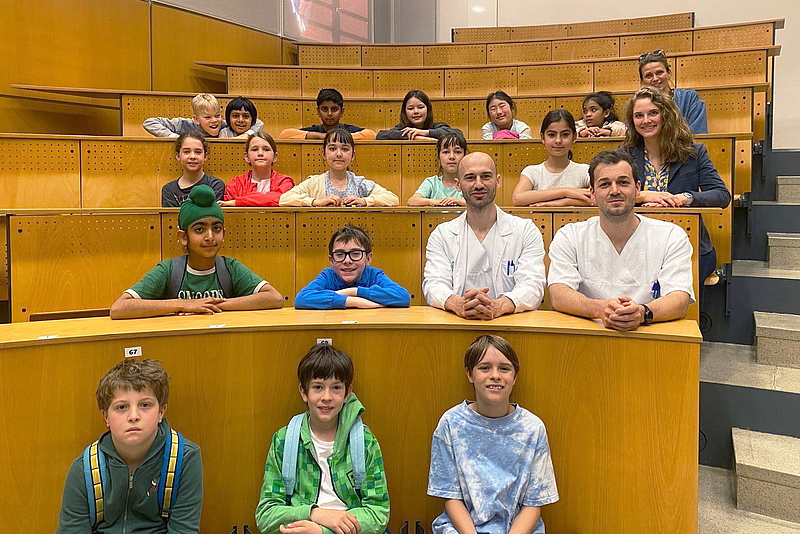
Whilst pupils across Austria have now started their summer holidays, the International Baccalaureate (IB) class at Smart City Graz Primary School had one more special item on their timetable just before the end of term. A visit to the Department of Otorhinolaryngology at the Medical University of Graz offered fascinating insights into medicine, research and everyday life at the clinic.
Workshop offers a hands-on approach to medicine and research
The International Baccalaureate (IB) is an internationally recognised, English-language school programme with a challenging curriculum specifically designed to prepare pupils for future university studies. For this reason, the workshop – which lasted around two and a half hours – was conducted entirely in English.
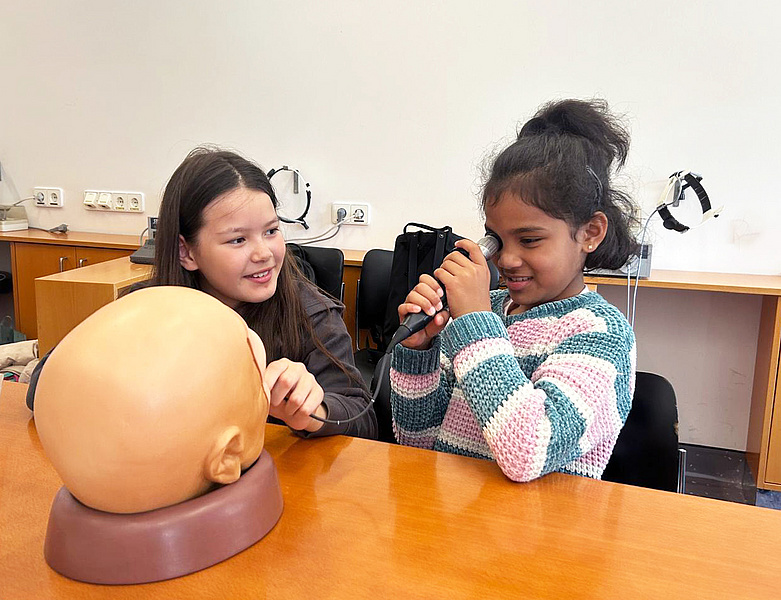
Following an introduction to ear, nose and throat medicine and research at the Department of Otorhinolaryngology, the pupils set off on a tour of discovery. Among other places, they visited the outpatient clinic, the wards, the operating theatre, the lecture theatre and the research laboratories. To round off the session, the pupils were able to get hands-on and experience first-hand what medicine and research look like in practice at various interactive stations.
The workshop was organised and led by ENT specialist Alexandros Andrianakis, who is regularly involved in fostering exchange between the scientific community and schools.
Alexandros Andrianakis on science communication
“I am very keen to get involved in such initiatives as an OeAD science ambassador, because they give children direct and engaging access to medicine and science. In ENT medicine in particular, it is possible to convey a great deal of information in a clear and engaging way and to actively involve the children, whether through experimentation, observation or joint discovery. My motivation is to spark curiosity, break down reservations and show that research is not abstract, but has a direct connection to people and health. In my view, such encounters are an important part of science communication and social responsibility.
I also consider such initiatives to be very valuable for us as a university, because they demonstrate what university medicine stands for: creating knowledge, passing on knowledge and taking responsibility towards society. I can only encourage my colleagues to get involved too. It is a very enriching experience, both for the children and for ourselves, because their questions, their openness and their enthusiasm often allow us to see our own subject in a whole new light,” says Alexandros Andrianakis.
We wish all the schoolchildren – and our own students too – a wonderful summer holiday and would like to thank Smart City Graz Primary School for their visit.