Innovative teaching projects: Acute and emergency medicine in primary care
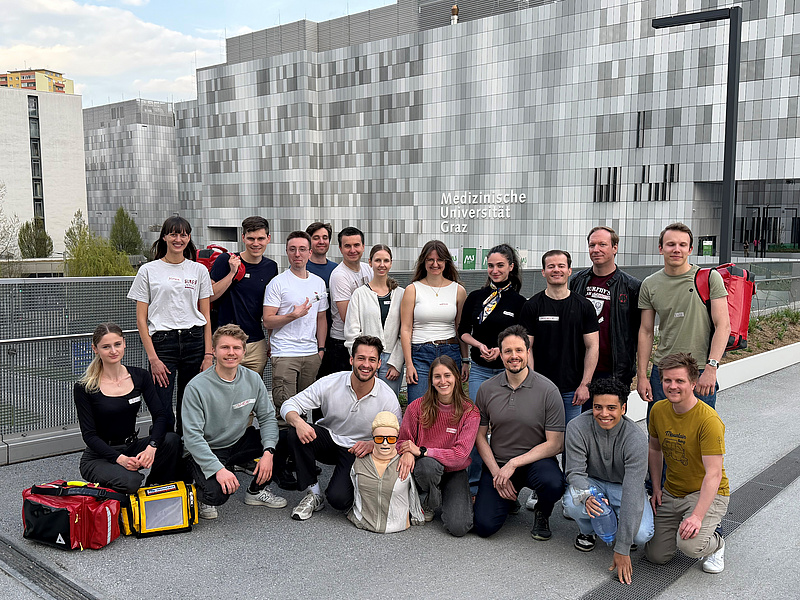
Acute emergencies can occur at any time in primary care – in a GP’s surgery, at a health centre, on on-call duty or at the interface with pre-hospital care. To prepare students specifically for these situations, the Institute of General Medicine and Evidence-based Care Research (IAMEV) at the Medical University of Graz has developed the practice-oriented elective module ‘Acute and Emergency Medicine in Primary Care’. The teaching format was initiated by Bernhard Kowalski and Andreas Prenner. At its heart is an innovative concept that strengthens practical competence through repeated, structured and reflective action.
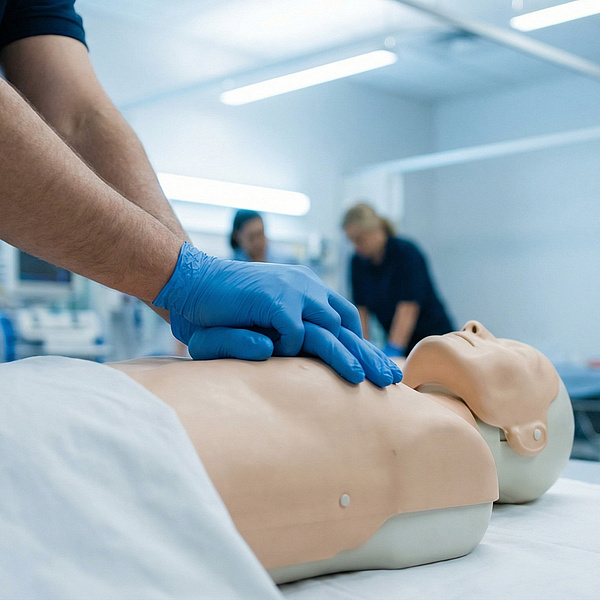
The elective is based on a specially developed rapid-sequence simulation concept. Common and relevant emergencies are practised in compact sequences. The aim is to promote professional confidence, clinical decision-making skills, prioritisation, team communication and a structured approach in acute situations.
In total, students work through 15 sequential simulation scenarios covering key acute care situations such as anaphylaxis, acute coronary syndrome, resuscitation, seizures, and asthma or COPD exacerbations. The scenarios are revisited several times, with the level of difficulty increasing gradually: from clearly recognisable presentations to atypical courses of the condition, greater pressure to make decisions and more complex requirements.
This teaching principle specifically promotes overlearning: procedures are repeatedly practised beyond the initial stage of confident mastery, consolidated and made accessible even under stress. This is particularly valuable in acute and emergency medicine, as in real-life emergency situations, rapid, structured and confident action is crucial for patient safety.
Another key focus is on crew resource management and non-technical skills. Team communication, clear role allocation, decision-making under pressure, prioritisation and the conscious handling of hierarchies are systematically integrated into the simulations. Students who are not actively in the treatment role remain involved through structured observation tasks.
The teaching format is multi-professional in nature. It is aimed at students of medicine and nursing and is delivered by a multi-professional team of tutors. This allows medical and nursing perspectives to be directly experienced through shared learning, training and reflection.
The debriefing is based on an adapted debriefing concept following the TALK model, which focuses on reflection, team learning and patient safety. The elective module thus provides a practice-oriented, competence-based and simulation-based teaching programme with transfer potential – and makes an important contribution to the further development of university teaching at the Medical University of Graz.