Forensic medical assessments are provided directly to victims of violence via telemedicine
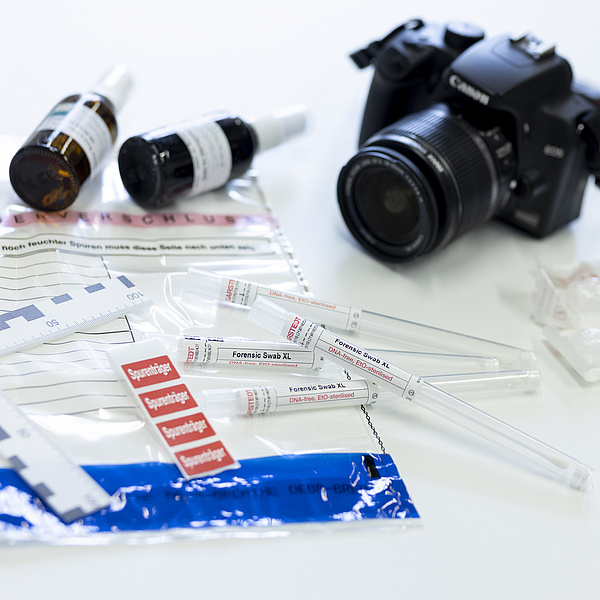 Gewaltschutz mittels Telemedizin
-
© Helmut Lunghammer
Gewaltschutz mittels Telemedizin
-
© Helmut Lunghammer
With the development of Forensic PETRA (Forensic Portable Equipment Tower for Remote Assistance), the Medical University of Graz is setting a new benchmark in the provision of telemedical care for victims of violence. With the support of the Social Affairs Department of the Province of Styria, which is funding the project and its continuation with a total of around 640,000 euros, a mobile system has been developed that makes forensic expertise available regardless of location, thereby significantly improving care for victims and the collection of admissible evidence.
Forensic PETRA: innovative telemedicine for care and evidence collection
Experiences of violence often cause significant physical and psychological distress for victims. This makes it all the more important to provide medical care, sensitive support and the collection of evidence admissible in court quickly and in a single location. This is precisely where the telemedicine solution Forensic PETRA comes in. It brings forensic medical expertise directly to where it is needed, thereby enabling comprehensive care and legally admissible documentation without the need for additional travel or delays.
Forensic PETRA is a mobile examination vehicle that combines all the technical components required for examination, communication and documentation within a self-contained system. “Doctors on site, for example in hospital outpatient departments, can act immediately whilst simultaneously drawing on the expertise of the forensic pathologists at the Medical University of Graz,” explains Sarah Heinze, Head of the Diagnostic and Research Institute of Forensic Medicine at the Medical University of Graz. Via a secure audio-visual link, the specialists monitor the examination in real time and add to the digital documentation directly.
The specially developed software enables the seamless recording of all examination results, photographic documentation and evidence. All data is transmitted in encrypted form to the Medical University of Graz and integrated into the violence clinic’s case management system. This ensures that findings are fully documented and securely stored in a manner admissible in court. Laboratory results received at a later date can also be incorporated into the digital case file. The highest standards of data protection and data security are consistently upheld.
For those affected, this telemedicine setting means, above all, rapid and sensitive support in a distressing situation. Forensic medical expertise is immediately available, without the need for additional travel or organisational hurdles. At the same time, personalised care is guaranteed, as patients can communicate directly with the forensic pathologists who are connected to the consultation.
Innovation and cooperation for better protection against violence
“With Forensic PETRA, we have succeeded in making forensic medical expertise available regardless of location, whilst ensuring the highest standards in documentation, quality and data protection. This telemedical innovation opens up new possibilities in the care of victims of violence and represents a significant step forward in the collection of evidence admissible in court,” emphasises Sarah Heinze.
For Rector Andrea Kurz, too, the project demonstrates the innovative strength of the Medical University of Graz: “Forensic PETRA is an outstanding example of how innovative research and digital development at the Medical University of Graz are translated into concrete solutions with significant societal benefits. The combination of medical excellence, technological progress and responsibility towards those affected is exemplary of our commitment.”
The development took place in close cooperation with the Province of Styria, which is actively driving forward the expansion of modern support services for victims of violence. “This innovative development is a true flagship project for modern victim protection. It makes it possible to make forensic medical expertise widely and immediately available. Victims of violence thus receive care and evidence collection at the highest professional standard – all in one place. Evidence can be collected accurately and in a manner admissible in court. At the same time, support is provided in a setting that minimises the strain on those affected as much as possible. This modern technology brings tangible improvements to victim protection in Styria. My thanks go to everyone who has contributed to the implementation of this pioneering project,” said Hannes Amesbauer, Regional Minister for Social Affairs of the Province of Styria.
With Forensic PETRA, the Medical University of Graz and the Province of Styria are underlining their pioneering role in innovative telemedical solutions for protection against violence. The system lays the foundations for providing forensic expertise flexibly and securely, thereby providing a significant impetus for the further development of protection against violence.
Further information

Diagnostic and Research Institute of Forensic Medicine
Medical University of Graz