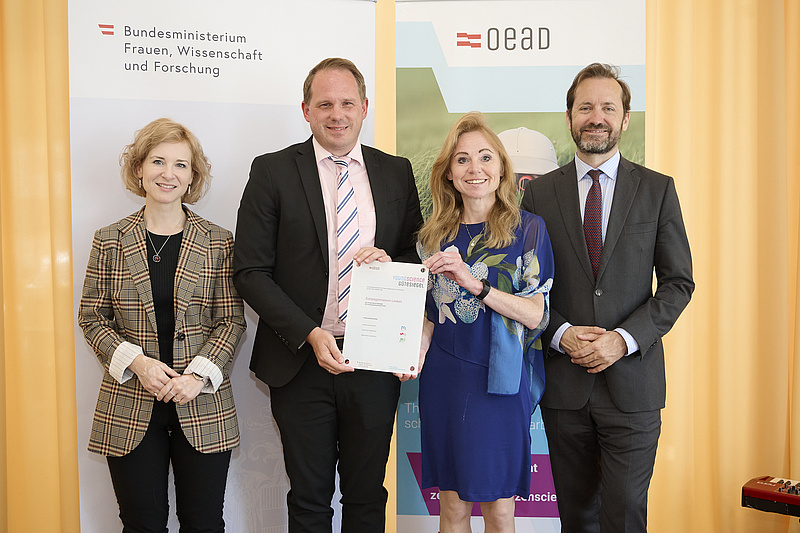
Young Science Seal of Quality awarded to two research partner schools of the Medical University of Graz
 ©eggeeggjiew - stock.adobe.com
In early June, the Federal Ministry for Women, Science and Research (BMFWF) and the Austrian Agency for Education and Internationalisation (OeAD) presented the Young Science Seal of Quality for research partner schools for the eighth time at the Education Lab in Vienna. Forty-two schools from seven federal states were honoured for their successful collaborations with research institutions, their research-oriented school focus and the active involvement of pupils in research processes. The award-winning schools impressed the jury with these achievements. The jury was made up of experts from the fields of research, science communication and school development. The Akademisches Gymnasium Graz and the Europagymnasium Leoben – research partner schools of the Medical University of Graz – were also presented with the seals of quality.
“The award-winning schools impressively demonstrate how research and science can be brought to life in everyday school life. They create access, break down barriers and open up new perspectives for young people. It is crucial that education and science should not depend on the family home or traditional role models. My thanks go to the dedicated school heads and teachers: they foster curiosity, creativity and trust in science,” says Federal Minister Eva-Maria Holzleitner.
Of the 50 schools that submitted a valid application, 42 were awarded the certificate – twelve for the first time and 30 as part of a recertification process. Among the award-winning schools are 16 vocational secondary schools, twelve academic secondary schools (AHS), eight primary schools and six lower secondary schools. Regionally, they are distributed as follows: twelve schools each in Vienna and Styria, nine in Upper Austria, five in Salzburg, two in Lower Austria, and one each in Tyrol and Carinthia.
“The research partner schools demonstrate just how diverse and dynamic education is conceived and practised today. Research collaborations open up new avenues for creative learning and demonstrate the schools’ keen interest in actively integrating science into the classroom. This commitment makes it clear that inquiry-based learning is a central component of a future-oriented educational landscape,” emphasises OeAD Managing Director Jakob Calice.
About the Young Science Seal of Quality
The Young Science Seal of Quality has been awarded by the Ministry of Science and the OeAD since 2012. It recognises schools that embed science and research sustainably in their school profile and actively involve their pupils in research processes. The seal is awarded for two years. Schools that have already received the award must demonstrate the further development of their research focus as part of the application process. A common feature of all research partner schools is the exceptional commitment and professionalism of their headteachers and teaching staff.
Four schools have held continuous certification since 2012: the HBLA Ursprung in Salzburg, the Akademisches Gymnasium Graz and the BRG Keplerstraße in Styria, and the HBLVA 17 for the chemical industry in Vienna.
All Austrian state and private schools are eligible to apply for the quality seal, provided they carry out projects in which pupils participate in research processes. Participation in research projects should also be reflected in the school’s profile and in research-oriented teaching programmes. Furthermore, it is not only individual pupils with a particular interest who should be involved in the projects, but entire school classes or larger groups.
See the list of award-winning schools: www.youngscience.oead.at/forschungspartnerschulen.
We offer our warmest congratulations!
Pictures: OeAD/APA Fotoservice - Hörmandinger