International Women's Day: Linda Waldherr is working on new approaches to cancer treatment
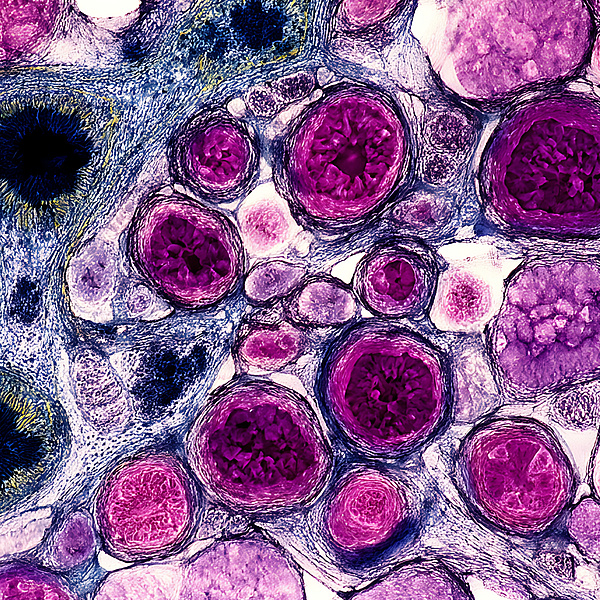 © rinrada - stock.adobe.com - generiert mit KI
The 32-year-old leads a research group investigating alternative dosing strategies for chemotherapy. The focus is not on the maximum dose, but on finely tuned administration. “We are interested in what happens when you rethink therapy in terms of time and space,” explains Linda Waldherr. For example, research is being conducted into whether drugs can be used more effectively and at the same time more gently over longer periods, in smaller quantities or targeted directly at the tumour.
A key component of this work, according to the researcher, are implants that release active substances directly at the tumour. These can be controlled remotely and enable significantly more precise treatment than conventional methods. The technologies are being developed through international collaborations with research partners in Sweden, Vienna, the Czech Republic and Hungary. Waldherr’s team contributes biological expertise and tests the implants in various tumour models to analyse their effects as accurately as possible.
“Back then, I didn’t know much about cancer”
What is now an international network involving dozens of researchers began on a comparatively modest scale – and, as she herself says, without preconceptions. During her PhD, she began her first experiments on brain tumours. The idea behind it: drugs should act as close as possible to where they are needed. “Back then, I didn’t know much about cancer. It was just an idea – but it proved to be a sensible one.” Today, the research is no longer limited to a specific type of tumour. The focus is on local effects and technologies that can be flexibly adapted to different tumours.
Linda Waldherr studied in Graz, initially chemistry, later biochemistry. The decision was a pragmatic one. “My father always said: if you can’t make up your mind, do the basics – then you’ll have a broad foundation.” Looking back, this was a good choice for the researcher, as many of her current projects draw on fundamental knowledge of chemistry.
As a woman in science, Linda Waldherr describes her experiences as largely positive. She speaks of strong support from her PhD supervisor and of an environment in which many women hold senior positions. At the same time, she sees structural weaknesses in the scientific system, such as fixed-term contracts or few long-term career prospects. The funding situation is particularly challenging at present. Research applications require a great deal of time and commitment, and rejections are common. “That can be frustrating,” she says – yet for her, motivation prevails.
A vision of treating tumours in a completely different way
What drives the researcher is the purpose of her work. “I really never ask myself: ‘Why am I doing this anyway?’” The vision of being able to treat tumours in a more targeted and gentler way in the future motivates her – as does working in a team and the international exchange with colleagues, says the biochemist. “We have a really good atmosphere. Everyone pulls together, and that’s incredibly enjoyable.”
In ten years’ time, Linda Waldherr sees herself still in research – provided the conditions are right. The young researcher finds balance away from the lab in the mountains, skiing or singing. Afterwards, she returns to her workplace – to continue working on new approaches to cancer therapy.
Source: APA-Science, 19 February 2026