Styria as a centre of excellence in cooperation: the reform debate meets real-world practice
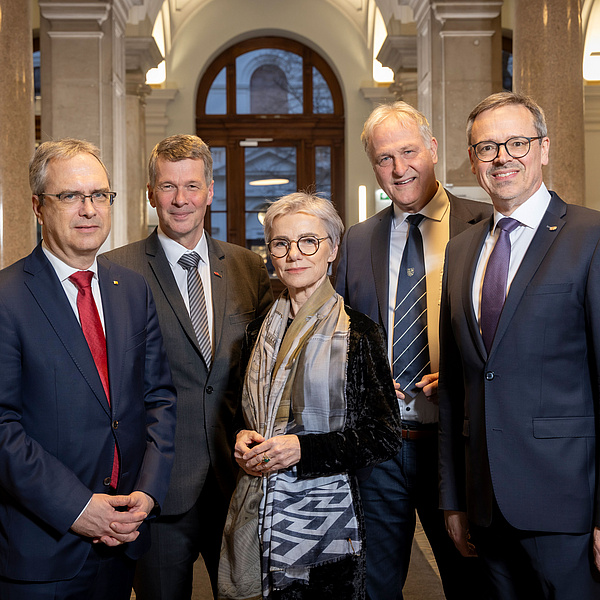 Die Rektor*innen der steirischen Universitäten
-
© Med Uni Graz/Helmut Lunghammer
Die Rektor*innen der steirischen Universitäten
-
© Med Uni Graz/Helmut Lunghammer
The Styrian universities support the current reform proposals put forward by the Austrian University Conference (uniko). The requirements currently being set out in terms of developing institutional profiles, cooperation and the efficient use of resources have been successfully put into practice in Styria for years. Experience in the region shows that collaboration and clear prioritisation work well and form an important basis for the further development of the Austrian higher education system.
Styria ranks among the top-performing science and research hubs in Europe. A key strength of the region lies in the close collaboration between its universities and research institutions. Numerous joint initiatives demonstrate that cooperation not only strengthens academic excellence but also enhances international visibility and generates sustainable added value for the economy and society.
The Styrian universities welcome the fact that political discussions and negotiations will continue throughout the summer. “We assume that reform plans and ideas will be negotiated independently of the current funding debate on the budgetary outlook up to 2030,” demand the Rectors of Styria’s universities, emphasising that an appropriate budgetary commitment must be made regardless of any long-term reforms.
Securing cooperation as a locational advantage
For over 20 years, the University of Graz and Graz University of Technology have maintained a joint natural sciences profile in research through NAWI Graz, offering their natural sciences degree programmes jointly at the same location and thus as a single programme.
BioTechMed-Graz brings together the strengths of the University of Graz, Graz University of Technology and the Medical University of Graz in the life sciences, thereby creating an internationally recognised platform for cutting-edge interdisciplinary research. Furthermore, with the Cori Institute of Molecular and Computational Metabolism of the Austrian Academy of Sciences, a research centre has been established in Graz that combines molecular and computer-based approaches and generates findings of great relevance to the medicine of tomorrow.
Cooperation is also consistently implemented in teaching. The joint Master’s programme in Psychotherapy offered by the Medical University of Graz and the University of Graz, starting in the winter semester 2026/27, is a prime example of the cross-institutional development of new educational programmes. The joint degree programme in Electrical Engineering and Sound Engineering, run by Graz University of Technology and the University of Music and Performing Arts Graz, which was established as far back as 1972, is regarded as one of the most successful examples of inter-university collaboration in Austria and as an international model for the integration of technology and the arts.
In the field of hydrogen research, Styria ranks among the top five research regions in Europe. To further expand its technological lead, the federal government invested a further 17 million euros just a few years ago in complementary infrastructure at Graz University of Technology and the Montanuniversität Leoben.
The Montanuniversität Leoben and Graz University of Technology cooperate closely within the network of Austrian technical universities, TU Austria, as is currently the case in a joint project with India.
Cooperation is also thriving in the field of campus management – the CAMPUSonline system, developed by Graz University of Technology, is used by all universities in southern Austria (and by a total of 44 higher education institutions in German-speaking countries). These are just a few examples of the wide-ranging collaborations in research, teaching and infrastructure, which illustrate that cooperation in Styria is not a one-off project, but a structurally embedded principle.
Securing the foundations for the future
The latest recommendations from FORWIT confirm this approach. To ensure that this successful model can continue to have an impact in the future, reliable framework conditions and university funding that can be planned for the long term are required. When it comes to funding decisions in particular, it is crucial to safeguard and further develop established cooperation structures, rather than jeopardising them through short-term measures.
Styria demonstrates that the future of the region as a centre for higher education and research lies not in isolation, but in collaboration.