Modern pathology opens up new treatment options for a rare tumour
 ©Helmut Lunghammer
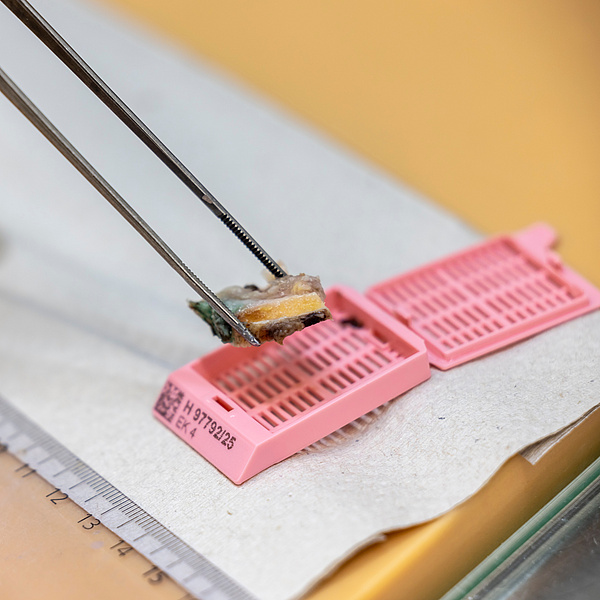
A team from the Medical University of Graz at the Diagnostic and Research Institute of Pathology has demonstrated, in a case that is unique worldwide to date, how modern molecular diagnostics can identify new treatment options even for very rare and aggressive tumours. The study was led by Bernadette Liegl-Atzwanger and was recently published in the journal Communications Medicine. Lead author Kristijan Skok provides insights into the diagnostic and scientific background of this particular case.
Accurate diagnosis brings hope for patients
The focus was on an extraskeletal osteosarcoma – an extremely rare, aggressive soft tissue tumour that develops outside the bones and spreads rapidly. Until now, only very limited treatment options have been available for this type of tumour. At the Diagnostic and Research Institute of Pathology at the Medical University of Graz, researchers succeeded for the first time worldwide in identifying a specific genetic alteration in this tumour entity. This precise molecular diagnosis had an immediate impact on patient care: the patient could be treated specifically using a TRK inhibitor. The therapy took effect rapidly, leading to a significant reduction in tumour size and sustained treatment success – with good tolerability and despite the tumour’s initial inoperability.
Modern pathology as the key to personalised medicine
This success was made possible by combining traditional pathological methods with state-of-the-art molecular genetic diagnostics. In addition to tissue examinations, modern genetic tests were primarily used to investigate genetic alterations at the RNA and DNA levels, as well as changes in gene copy number. “This case impressively demonstrates that comprehensive molecular tumour analyses are also useful in cases where targeted therapies were not previously expected,” emphasises Kristijan Skok. “If we identify the molecular trigger of a disease, we can open up new treatment pathways even for the rarest tumours,” adds the pathologist.
Interdisciplinary collaboration for patients
The success of the treatment is the result of close interdisciplinary collaboration between the University Comprehensive Cancer Centre Graz and clinical partners from orthopaedics, oncology and radiology, as well as in cooperation with the Order Hospital of the Sisters of Mercy in Linz. The Department of Pathology at the Medical University of Graz provided the crucial information for the treatment decision in accordance with current international guidelines.
Significance beyond the individual case
The published case highlights the growing importance of tumour-agnostic therapeutic approaches and advocates for the consistent integration of molecular diagnostics in rare tumour types. In future, structured testing algorithms and AI-supported analyses of imaging and molecular data are expected to further increase diagnostic precision.
Publication:
Extraskeletal osteosarcoma harbouring ETV6::NTRK3 fusion treated successfully with larotrectinib: a case study
| Communications Medicine
Extraskeletal osteosarcoma harbouring ETV6::NTRK3 fusion treated successfully with larotrectinib: a case study | Communications Medicine